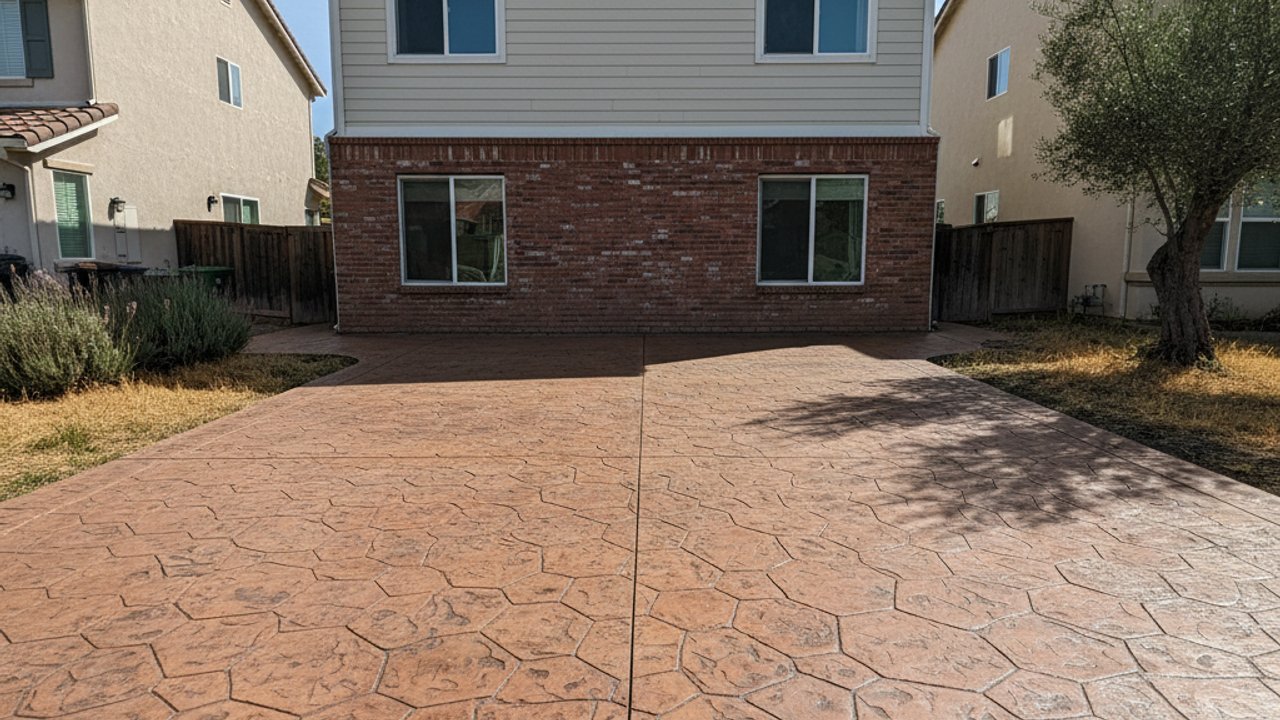
Concrete work looks simple from the sidewalk. A truck shows up, forms go in, gray stuff gets poured and troweled flat, and a few days later you've got a driveway. What you don't see is the part that decides whether that slab lasts twenty years or cracks apart in five, and that part happens before the truck ever arrives.
Palo Alto has its own version of this problem. If you're spending real money on a driveway, patio, foundation repair, or a retaining wall, here's what actually separates a contractor worth hiring from one you'll be calling back in two winters.
What the ground here does to concrete
A lot of the flatland east of El Camino sits on clay soil, and closer to the Baylands you get into old bay mud, which is soft, compressible, and holds water. Clay expands when it's wet and shrinks hard when it dries out, and that movement pushes and pulls on whatever's sitting on top of it. A slab poured on unprepared clay will crack along its own schedule, not yours.
Neighborhoods like Crescent Park and Old Palo Alto also have mature oaks and redwoods with root systems that don't respect property lines. Roots under a walkway or driveway edge will lift a slab a half inch over a few years, and no amount of steel in the concrete fixes that if the base underneath isn't dealt with first. A contractor who knows the area will ask about nearby trees before they ask about color or finish.
The fix isn't complicated, it's just often skipped. That's 4 to 6 inches of compacted class 2 aggregate base under a driveway slab, more if the existing soil tests soft, plus proper grading so water moves away from the house instead of pooling against the foundation. Skipping the base prep is the single most common shortcut in this trade, and it's invisible once the concrete is down.
Permits and how the city actually handles this
Most driveway, patio, and foundation work in Palo Alto needs a permit through the city's Development Services division, and any work that touches the sidewalk, curb, or the strip between sidewalk and street needs an encroachment permit as well, since that's public right-of-way. A legitimate contractor pulls these themselves, not you, and they know the difference between the two.
Inspections typically happen at two points: after the forms and any rebar or mesh are set, before the pour, and sometimes again afterward depending on the scope. If a contractor tells you permits aren't necessary for a driveway replacement or a new patio slab, that's a bid you should be careful with. Skipping the permit doesn't just risk a fine, it means nobody ever checked the base compaction or the steel placement, which is exactly the stuff you can't see once it's covered.
Palo Alto doesn't have HOAs the way some newer Bay Area suburbs do, aside from a handful of newer condo and planned developments. Setback and property line questions come up more with older lots that were subdivided decades ago, where the recorded lines don't always match the fence that's been standing there since 1962. Worth a quick check before a retaining wall or new slab goes anywhere near a property line.
What a real bid should actually say
A one-line number on a piece of paper isn't a bid, it's a guess. Ask for the base depth, whether they're using rebar or wire mesh, and where the control joints go. For a driveway carrying car and truck weight, 4 inches of slab thickness is standard, sometimes 5 for a heavier vehicle or an RV pad. Patios and walkways can often run at 4 inches with less base prep, since foot traffic doesn't load the slab the way tires do.
Rebar (usually #3 or #4 bar) holds a cracked slab together and keeps the two sides level with each other. Wire mesh is cheaper and lighter, and it's fine for a lot of patios, but it tends to sag to the bottom of the pour if it's not held up on chairs during placement, which defeats the point of using it at all. Ask which one they're using and why.
Control joints matter more than people think. Concrete is going to crack somewhere as it cures and shrinks, and a joint is just a place you've told it to crack instead of leaving it to pick its own spot. These get saw-cut within 24 hours of the pour, spaced roughly 8 to 10 feet apart depending on slab thickness. A contractor who pours a large slab with no joint plan is setting you up for a random crack across the middle in a year or two.
Timing, curing, and the summer heat problem
Concrete needs about 7 days before it can handle vehicle weight and closer to 28 days to reach full design strength. Anyone telling you to park a car on a driveway the next day is either wrong or doesn't care. Palo Alto summers bring long stretches of dry heat, and hot, dry curing conditions pull moisture out of a slab faster than it can hydrate properly, which weakens the surface and can cause it to crack or dust. A contractor who's done this work locally will cover a fresh pour or wet-cure it during a July or August pour, not just leave it to the sun.
Rain isn't usually the enemy here the way it is in other parts of the country, since Palo Alto's wet season runs roughly November through March and most residential pours happen outside that window anyway. But a poorly timed pour ahead of a storm can still get rained on before it's set, which messes up the surface finish even if the strength holds up underneath.
Red flags worth walking away from
- A bid with no mention of base preparation or soil conditions at all.
- Cash-only pricing with no written contract or permit mentioned.
- A price that's dramatically lower than three other bids for the same square footage and thickness.
- No local references, or references only from outside the area, for work on similar soil conditions.
- Pressure to sign and start the same week, especially before a permit has even been discussed.
None of these alone means someone's a fraud. Together, they're a pattern, and it's the same pattern that shows up in the slabs we get called to repair five years later.
If you're weighing a driveway, a patio, or a foundation repair anywhere from Barron Park to Crescent Park, the questions above will tell you more about a contractor in ten minutes than any brochure will. You can see how we approach these jobs, including base prep, permitting, and steel placement, on Coastal Concrete's site, and we're happy to walk through a bid line by line before you sign anything.